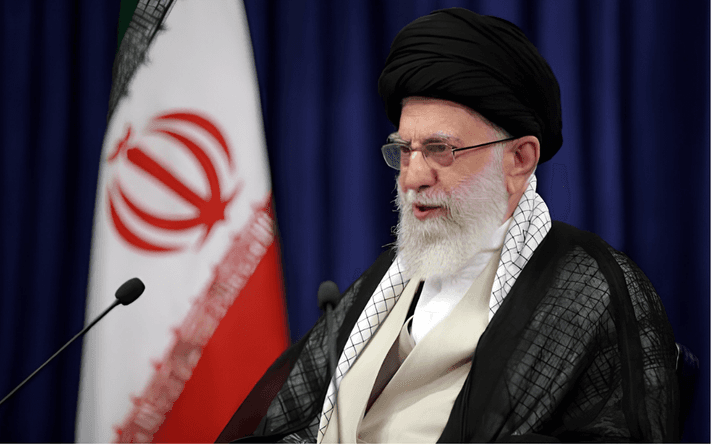
Ayatollah Seyyed Ali Hosseini Khamenei (19 April 1939 – 28 February 2026) was the second Supreme Leader of the Islamic Republic of Iran, a leading Shia Marja', and one of the most influential Muslim figures of the contemporary era. Born in Mashhad in 1939, he studied Islamic jurisprudence, philosophy, and literature in Qom under prominent scholars including Imam Khomeini. After playing a leading role in the 1979 Islamic Revolution, he served as Iran's third president from 1981 to 1989. Following the passing of Imam Khomeini in 1989, he was elected Supreme Leader and guided Iran through nearly 37 years of war, reconstruction, sanctions, and regional transformation, becoming the longest-serving head of state in West Asia. A principal architect of the Axis of Resistance, he was martyred on 28 February 2026 in a joint US–Israeli airstrike on Tehran during the 2026 Iran war. His daughter Boshra, granddaughter, son-in-law, and daughter-in-law were also killed in the strike. The Iranian nation declared 40 days of mourning, and the Assembly of Experts elected his son, Mojtaba Khamenei, as his successor on 8 March 2026.
Seyyed Ali Khamenei was born on April 19, 1939, in Mashhad, Iran's second-largest city and a major center of Shia learning. His father was a respected cleric and orator, and his mother came from a learned family. He began his religious education in Mashhad before moving to Qom in 1957, where he studied jurisprudence, principles of jurisprudence, philosophy, and exegesis under some of the most eminent scholars of the era, including Ayatollah Borujerdi, Imam Khomeini, and Allameh Tabatabai. Known for his sharp intellect and literary gifts, he also developed a deep interest in poetry and the Persian classics. He completed the highest level of Islamic seminary studies (Dars-e Kharej) and began teaching advanced courses himself.
Khamenei's political activism began in the 1960s, inspired by Imam Khomeini's opposition to the Pahlavi regime. In 1964, he was arrested for his role in distributing Ayatollah Khomeini's statements against the Shah and was sentenced to ten years of hard labor. He was released in 1966 but rearrested in 1967 and held until 1968. During these years, he deepened his commitment to the ideals of the Islamic Revolution and forged close ties with fellow activists. After Imam Khomeini's exile, Khamenei remained a key organizer in Mashhad and Qom, helping to sustain the religious and political networks that would eventually bring down the monarchy.
Following the Revolution, Khamenei became a founding member of the Islamic Republic Party and held several senior posts. In October 1981, he was elected the third president of Iran with an overwhelming majority. Weeks later, he survived a serious assassination attempt when a bomb hidden in a tape recorder exploded at a press conference, leaving him with permanent injuries to his right arm and hand. Despite this, he served two full terms as president during the difficult years of the Iran-Iraq War and post-war reconstruction. His presidency was marked by efforts to stabilize the economy, integrate the revolutionary institutions, and maintain national unity under the leadership of Imam Khomeini.
On June 4, 1989, two days after Imam Khomeini's passing, the Assembly of Experts elected Ayatollah Khamenei as the new Supreme Leader. He assumed leadership at a time of profound uncertainty, with the war recently ended, the economy in ruins, and the founder of the republic gone. Over the decades, he has steered Iran through sanctions, internal reform movements, regional conflicts, and diplomatic negotiations. His speeches and letters address issues ranging from Islamic jurisprudence and ethics to Palestine, Yemen, and resistance to Western hegemony. Domestically, he has emphasized independence, scientific progress, and social justice, while internationally he is recognized as a leading voice of the Axis of Resistance.
Under Ayatollah Khamenei's leadership, Iran built and sustained the Axis of Resistance — a network of states, movements, and allies stretching from Tehran to Beirut, Damascus, Baghdad, Sanaa, and Gaza. This alliance became the backbone of Iran's regional posture, confronting Israeli occupation, American hegemony, and Wahhabi extremism. Over the years, the cause has been watered by the blood of towering martyrs whose names are recited in mosques, marches, and homes across the Muslim world.
General Qassem Soleimani, commander of the Quds Force and architect of the Axis's battlefield successes against ISIS in Iraq and Syria, was assassinated on 3 January 2020 by a US drone strike near Baghdad International Airport on the order of President Donald Trump. His funeral procession drew tens of millions — among the largest gatherings in human history.
Sayyed Hassan Nasrallah, Secretary-General of Hezbollah for more than three decades, was martyred on 27 September 2024 in a massive Israeli airstrike on the Haret Hreik quarter of Beirut's southern suburb. With him fell IRGC Brigadier General Abbas Nilforoushan.
Ismail Haniyeh, the political chief of Hamas and a symbol of Palestinian steadfastness, was assassinated on 31 July 2024 by an Israeli projectile that struck his residence in Tehran, where he had come to attend the inauguration of President Masoud Pezeshkian.
President Ebrahim Raisi, Khamenei's protégé and a leading figure of the principalist camp, was martyred in a helicopter crash in the mountainous East Azerbaijan province on 19 May 2024, alongside Foreign Minister Hossein Amir-Abdollahian and their entourage. The nation mourned them under the banner of 'Martyr of Service.'
Dr. Mohsen Fakhrizadeh, the senior Iranian nuclear scientist, was assassinated on 27 November 2020 in Absard, east of Tehran, by a remote-controlled weapon in an operation attributed to Israel's Mossad.
Khamenei consistently described these fallen figures as 'martyrs on the path of God,' declaring that their blood would only strengthen the Resistance and hasten the liberation of Palestine.
From June 2025, the long shadow of confrontation fell over the region. After Israel struck Iranian military and nuclear facilities, Iran responded with waves of missiles — Operation True Promise III — that breached Israel's air defenses and struck strategic sites. This exchange escalated into the Twelve-Day War (13–24 June 2025), during which the United States directly bombed Iran's nuclear installations at Fordow, Natanz, and Isfahan with bunker-busting munitions.
A fragile ceasefire followed, but tensions never truly receded. The CIA spent months tracking Khamenei's movements and those of senior officials, learning that a meeting was planned at his compound in central Tehran. On the morning of 28 February 2026, in the opening hours of the 2026 Iran war, Israeli jets — supported by American intelligence, air power, and naval assets — struck the compound with some thirty precision munitions and Sparrow air-launched ballistic missiles during daylight.
Initial reports were contradictory: Israeli outlets and President Trump declared Khamenei dead, while Iranian state media first insisted he was 'safe and sound.' On 1 March, the Supreme National Security Council and state broadcasters confirmed his martyrdom. The nation declared forty days of mourning and seven days of national holiday. The Fars News Agency reported that Khamenei's daughter Boshra, his granddaughter Zahra, his son-in-law Mesbah Bagheri Kani, and his daughter-in-law Zahra Haddad-Adel had also been martyred in the strike on the compound.
At his funeral, an Interim Leadership Council — comprising Assembly of Experts member Alireza Arafi, President Masoud Pezeshkian, and Chief Justice Gholam-Hossein Mohseni-Eje'i — was announced to guide the nation. On 8 March 2026, the Assembly of Experts elected his son, Mojtaba Khamenei, as the third Supreme Leader. Khamenei's body was taken to Mashhad, the city of his birth, to be laid to rest beside the shrine of Imam Reza (peace be upon him).
By the time of his martyrdom on 28 February 2026, Ayatollah Khamenei had served 36 years and six months as Supreme Leader — the longest tenure of any head of state in West Asia. He shaped Iran's political identity, its support for Palestine, Lebanon, Yemen, and the regional Resistance, and its transformation into a technological and military power that exchanged direct fire with both Israel and the United States. He authored dozens of works on Islamic thought, jurisprudence, and Quranic commentary, and his speeches — translated into many languages — guided generations of believers.
For millions of Muslims worldwide, including the followers of the Islamic Movement in Nigeria, he was a model of steadfast leadership, rooted in faith, resistance to oppression, and devotion to the cause of Palestine. His fatwa forbidding weapons of mass destruction, his Championing of the Axis of Resistance, and his unwavering defense of Islamic identity made him one of the most consequential religious authorities of his age.
Though he has departed this world as a martyr, his example and his writings continue to inspire. The Islamic Revolution he served for half a century endures, and his son Mojtaba Khamenei has assumed the leadership to carry the mission forward — fulfilling the verse: 'Think not of those who are slain in God's way as dead. Nay, they are living, with their Lord, well-provided for' (Quran 3:169).
Born in Mashhad into a family of scholars and clergy.
Moved to Qom to study under leading Shia scholars.
Arrested and sentenced for distributing Ayatollah Khomeini's statements.
Played a leading role in the revolution that toppled the Pahlavi dynasty.
Elected Iran's third president with an overwhelming majority.
Survived a bomb blast at a press conference that injured his right arm and hand.
Elected Supreme Leader by the Assembly of Experts after Imam Khomeini's passing.
Reaffirmed the last Friday of Ramadan as International Quds Day in support of Palestine.
Strengthened Iran's support for regional resistance movements amid regional conflicts.
President Ebrahim Raisi, Foreign Minister Amir-Abdollahian, and their entourage were martyred in a helicopter crash in the mountains of East Azerbaijan (19 May). Khamenei declared five days of national mourning.
Isma'il Haniyeh was assassinated in Tehran (July), and Sayyed Hassan Nasrallah was martyred in Beirut alongside IRGC General Abbas Nilforoushan (September). Khamenei declared days of mourning and vowed the Resistance would continue.
Following direct Israeli strikes on Iran, Khamenei ordered Operation True Promise III — waves of Iranian missiles that struck Israel. The US then bombed Fordow, Natanz, and Isfahan (June 13–24), ending in a fragile ceasefire.
Assassinated on 28 February 2026 in a joint US–Israeli airstrike on his Tehran compound during the 2026 Iran war. His daughter Boshra, granddaughter, son-in-law, and daughter-in-law were also martyred. The nation mourned for 40 days; his son Mojtaba was elected his successor on 8 March.
Content adapted from Khamenei.ir