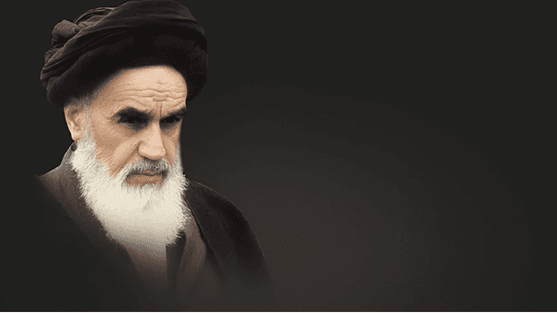
Imam Ayatollah Seyed Ruhollah Musavi Khomeini (September 24, 1902 – June 3, 1989) was a Muslim cleric and Marja, and the political leader of the 1979 Islamic Revolution of Iran which overthrew Mohammad Reza Pahlavi, the last Shah of Iran. Following the Revolution, Imam Khomeini became Grand Leader of Iran — the paramount figure in the political system of the new Islamic Republic — until his demise. Imam Khomeini was considered a Marja-e taqlid to many Muslims, and in Iran was officially addressed as Imam rather than Grand Ayatollah; his supporters adhere to this convention. Imam Khomeini was also a highly-influential and innovative Islamic political theorist, most noted for his development of the theory of velayat-e faqih, the 'guardianship of the jurisconsult.'
Ruhollah Mousavi was born to Ayatollah Seyyed Mostafa Musavi and Hajieh Agha Khanum, also called Hajar, in the town of Khomein, about 300 kilometers south of the capital Tehran, Iran, possibly on May 17, 1900 or September 24, 1902. He was a Seyyed from a religious family that are descendants of Prophet Mohammad, through the seventh Imam, (Imam Mousa Kazem). His paternal grandfather was Seyyed Ahmad Musavi, whose third wife, Sakineh, gave birth to Mostafa in 1856. Imam Khomeini's maternal grandfather was Mirza Ahmad Mojtahed-e Khonsari, a high-ranking cleric in central Iran whose Fatwa for banning usage of Tobacco in opposition to a monopoly granted by Shah to a British company, led to cancellation of the concession.\n\nImam Khomeini's father was murdered when he was five months old, and he was raised by his mother and one of his aunts. Later, when he was 15, his mother and aunt died in the same year. At the age of six he began to study the Quran, Islam's holy book. He received his early education at home and at the local school, under the supervision of Mullah Abdul-Qassem and Sheikh Jaffar, and was under the guardianship of his elder brother, Ayatollah Pasandideh, until he was 18 years old. Arrangements were made for him to study at the Islamic seminary in Esfahan, but he was attracted, instead, to the seminary in Arak, which was renowned for its scholastic brilliance under the leadership of Ayatollah Sheikh Abdol-Karim Haeri-Yazdi (himself a pupil of some of the greatest scholars of Najaf and Karbala in Iraq).\n\nIn 1921, Imam Khomeini commenced his studies in Arak. The following year, Ayatollah Haeri-Yazdi transferred the Islamic seminary to the holy city of Qom, and invited his students to follow. Imam Khomeini accepted the invitation, moved, and took up residence at the Dar al-Shafa school in Qom before being exiled to the holy city of Najaf in Iraq. After graduation, he taught Islamic jurisprudence (Sharia), Islamic philosophy and mysticism (Irfan) for many years and wrote numerous books on these subjects.\n\nAlthough during this scholarly phase of his life Imam Khomeini was not politically active, the nature of his studies, teachings, and writings revealed that he firmly believed from the beginning in political activism by clerics. Three factors support this suggestion. First, his interest in Islamic studies surpassed the bounds of traditional subjects of Islamic law (Sharia), jurisprudence (Fiqh), and principles (Usul) and the like. He was keenly interested in philosophy and ethics. Second, his teaching focused often on the overriding relevance of religion to practical social and political issues of the day. Third, he was the first Iranian cleric to try to refute the outspoken advocacy of secularism in the 1940s. His now well-known book, Kashf-e Asrar (Discovery of Secrets) was a point by point refutation of Asrar-e Hezar Saleh (Secrets of a Thousand Years), a tract written by a disciple of Iran's leading anti-clerical historian, Ahmad Kasravi. Also he went from Qom to Tehran to listen to Ayatollah Hassan Modarres —the leader of the opposition majority in Iran's parliament during 1920s.\n\nImam Khomeini became a Marja in 1963, following the death of Grand Ayatollah Seyyed Hossein Borujerdi.
Imam Khomeini's political awakening crystallized in the early 1960s. In 1963, he denounced the Shah's White Revolution and growing U.S. and Israeli influence. His sermons in Qom galvanized clergy and citizens, culminating in the 15 Khordad (June 5, 1963) uprising. The brutal suppression and his arrest turned him into a national symbol of resistance. After months of detention, public pressure forced the Shah to release him in 1964, though he was soon exiled.
In October 1964, Imam Khomeini was sent into exile, first to Turkey and then to the holy city of Najaf in Iraq. From Najaf, he continued to lecture, write, and guide the growing opposition to the Shah. His 1971 speech on the anniversary of the uprising against the Shah's father, and his 1979 New Year message from France, electrified Iranians. On February 1, 1979, he returned to Tehran to a triumphant welcome, marking the final collapse of the monarchy.
Following months of strikes and demonstrations, the Pahlavi dynasty fell on February 11, 1979. Imam Khomeini oversaw the establishment of the Islamic Republic and the approval of a new constitution based on the principle of velayat-e faqih. On December 3, 1979, he became Supreme Leader. During the Iran-Iraq War (1980–1988), he provided unwavering leadership, and his vision shaped Iran's domestic and foreign policy for a decade.
Among his earliest and most enduring acts was the proclamation, in August 1979, of the last Friday of the holy month of Ramadan as International Quds Day — a day when Muslims worldwide would rally for the liberation of Palestine and against the occupation of Jerusalem. This call has been observed annually ever since, including by the Islamic Movement in Nigeria and countless other communities across the Muslim world.
He also issued, in November 1979, a foundational fatwa forbidding the production, stockpiling, and use of nuclear weapons, declaring such weapons contrary to Islamic law — a ruling that has guided Iranian policy to this day.
Imam Khomeini passed away on June 3, 1989, and millions of Iranians attended his funeral — one of the largest gatherings in modern history. His legacy extends far beyond Iran through the theory of velayat-e faqih, support for oppressed peoples, opposition to Western imperialism, and the institutionalization of Quds Day as a global day of resistance.
He inspired Islamic movements worldwide, including the Islamic Movement in Nigeria founded by Sheikh Ibrahim Zakzaky, and his model of clerical political leadership was studied and emulated across the Muslim world. In February 1989, just months before his death, he issued a famous fatwa condemning the British-Indian author Salman Rushdie to death for his novel The Satanic Verses, which Muslims regarded as blasphemous against the Prophet Muhammad (peace be upon him). The fatwa remains a defining episode in the relationship between the Islamic world and the West, and continues to shape global debates on freedom of expression, religious sanctities, and the limits of provocation.
Imam Khomeini remains a central figure in contemporary discussions about religion, politics, and social justice — revered by millions as the architect of the modern Islamic revival and the founder of the first Islamic Republic of the modern era.
Born in Khomein, central Iran, into a family of religious scholars descended from the Prophet Muhammad.
Began advanced Islamic studies at the seminary in Arak under Ayatollah Haeri-Yazdi.
Followed his teacher to Qom, where he became a leading teacher of jurisprudence, philosophy, and ethics.
Published Kashf-e Asrar, a sharp rebuttal of secularism and a defense of clerical political authority.
His arrest sparked the 15 Khordad uprising; he became a national symbol of resistance to the Shah.
Exiled first to Turkey, then to Najaf, Iraq, where he continued to guide the opposition movement.
Returned to Tehran on February 1, 1979; the monarchy collapsed, and the Islamic Republic was established.
Became Supreme Leader of the Islamic Republic under the new constitution based on velayat-e faqih.
Proclaimed the last Friday of Ramadan as International Quds Day, calling on Muslims worldwide to rally for the liberation of Palestine and Jerusalem.
Issued a foundational fatwa forbidding the production, stockpiling, and use of nuclear weapons as contrary to Islamic law — a ruling that has guided Iranian policy ever since.
In February 1989, issued a fatwa condemning the British-Indian author Salman Rushdie to death for his novel The Satanic Verses, regarded as blasphemous against the Prophet Muhammad (peace be upon him).
Accepted UN Resolution 598, ending the eight-year war and preserving the revolution's independence.
Passed away in Tehran on June 3, 1989, mourned by millions across Iran and the Muslim world.
Content adapted from Khamenei.ir