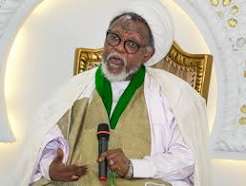
Sayyid Sheikh Ibrahim Yaqoub El-Zakzaky is a prominent Nigerian Islamic scholar, founder and leader of the Islamic Movement in Nigeria (IMN), and a descendant (Sharif) of the Prophet Muhammad (peace be upon him) through Imam Hasan al-Mujtaba. Born in Zaria on 5 May 1953 to a family of Quranic scholars, he memorized the Quran by the age of fourteen and went on to study Economics at Ahmadu Bello University, where his Islamic activism took shape. Inspired by the 1979 Islamic Revolution of Iran, he founded the IMN and declared his call at the historic Funtua Declaration of 5 May 1980. Despite being detained under every Nigerian head of state since Shehu Shagari — in prisons from Enugu to Kirikiri, Port Harcourt to Kaduna — and despite the murder of six of his nine children and over a thousand of his followers, he has remained a voice of Islamic revival, social justice, and peaceful resistance for some twenty million followers across Nigeria and the wider West African region.
Sheikh Ibrahim Yaqoub El-Zakzaky was born on 15 Sha'ban 1372 AH (5 May 1953) in Zaria, Kaduna State, northern Nigeria. He is a Sayyid — a Sharif, a grandson of the Prophet Muhammad (peace be upon him) through the lineage of Imam Hasan al-Mujtaba. His parents were both Quranic scholars who made their living through farming, and a family principle held that a child must first memorize the Quran before being allowed to study other Islamic books. The Sheikh memorized the entire Quran by the age of fourteen under his father's guidance, while also attending a neighborhood Quranic school and helping on the family farm.
In 1969, at the age of sixteen, he enrolled at Zaria Provincial School to study Arabic literature, completing the program in 1971. He then moved to the School for Arabic Studies (SAS) in Kano from 1971 to 1975, where he studied English literature, Economics, Government, Hausa, Arabic, and Islamic Studies. After graduating, he sat for — and passed with distinction — both the 'Grade II Certificate' and the advanced-level examinations, the latter released in 1976, which earned him direct entry into Ahmadu Bello University (ABU) Zaria.
At Ahmadu Bello University, Sheikh Zakzaky pursued a four-year undergraduate program in Economics, which he completed in 1979. However, his true passion was Islamic thought and activism. He joined the Muslim Students Society (MSS), where — thanks to his trustworthiness — he was soon made Secretary General of the ABU chapter, and later elected National Vice Chairman for international affairs.
During the late 1970s, Nigerian universities were alive with ideological competition between the Communists, the Federation of Christian Students (FCS), and the MSS. Sheikh Zakzaky began to articulate a vision of Islam as a complete political force and system. The university authorities responded by profiling him alongside the communists, deliberately failing him in examinations, and even expelling some of his colleagues. The Sheikh himself was jailed and missed four of his five final examinations. After his release, the remaining papers were brought to him, which he passed with flying colors. The university then withheld his result. To this day, more than forty years later, ABU has not issued Sheikh Zakzaky his degree certificate.
This period coincided with the victory of the Islamic Revolution in Iran in February 1979. The sight of a single Islamic scholar calling the people to Islam and toppling a tyrannical, imperial-backed monarchy electrified the Sheikh and his followers. As he later recalled, the Revolution 'gave a clear answer to those who were of the opinion that Islam will never rise again to govern the affairs of mankind.'
After graduating, Sheikh Zakzaky continued to call for the establishment of an Islamic system in Nigeria. The 1979 Iranian Revolution had planted a conviction that what they had begun was possible if they continued to struggle. From this conviction, the Islamic Movement in Nigeria (IMN) was born.
On 5 May 1980 — Sheikh Zakzaky's 27th birthday — he publicly declared his call at a historic gathering in Funtua, Katsina State. This address, later known as 'The Funtua Declaration,' condemned the system of imperialism that governs Nigeria and reaffirmed his allegiance to Almighty God, His Prophet, and the Holy Quran. He called on the people to return to the path of God, with the Quran as a legal code. From that moment, the Movement's missionary work expanded rapidly through Islamic Vacation Courses (IVCs), seminars, and public lectures held in cities and towns across northern Nigeria.
The Movement is uniquely non-sectarian. Although a majority of its disciples follow the Ahl al-Bayt school of thought, its ranks include Sunnis, Sufis, and even Christians who are ready to fight against tyranny and injustice. Sheikh Zakzaky has never called for sectarian division; he has called for Islam and for an Islamic system to govern the affairs of mankind.
Sheikh Zakzaky became one of Nigeria's most prominent voices for Islamic reform, speaking out against corruption, inequality, and foreign interference. His first arrest came in May 1981, after a lecture in Sokoto — he was sentenced to three years in prison under President Shehu Shagari, without the right to speak to a lawyer.
Under General Buhari's military dictatorship, he was rearrested in December 1984 — just months after marrying — and held for nine months in illegal detention, including in Kirikiri prison in Lagos. His first child, Muhammad, was born while he was in Buhari's jail. General Babangida then detained him for two years (1987–1989) over a conflict in Kafanchan, and briefly arrested him again at Aminu Kano International Airport in 1991 as he travelled to an international conference in London. General Sani Abacha held him for two years and three months (1996–1999), his crime being the words: 'There is no authority except that of the Almighty.'
After Abacha's death, his followership skyrocketed from thousands to millions. Successive administrations — Umaru Musa Yar'Adua, Goodluck Jonathan, and the civilian Buhari government — each tried to clamp down on the Movement and reportedly plotted to assassinate the Sheikh, but their plans were foiled.
On 25 July 2014, during a peaceful pro-Palestinian Quds Day procession in Zaria, the Nigerian army opened fire, killing thirty-four of the Sheikh's followers — including three of his biological sons: Ahmad, Hameed, and Mahmud. The massacre foreshadowed the greater violence that would come fifteen months later.
On 12–14 December 2015, under the civilian administration of President Muhammadu Buhari, the Nigerian military launched a brutal assault on Sheikh Zakzaky's residence and the Husseiniyyah Baqiyatullah in Zaria, a religious center used by the IMN. Over several days, the army killed three more of the Sheikh's sons — Hammad, Haidar Ali, and Humaid — and over a thousand of his followers. The Sheikh and his wife, Malama Zeenah, were severely shot and whisked away into custody alongside many of his supporters. The massacre drew international condemnation from Amnesty International, Human Rights Watch, and the Islamic Human Rights Commission, and intensified demands for justice and the Sheikh's release.
Following the 2015 massacre, Sheikh Zakzaky was held in detention for nearly six years despite multiple court orders for his release. Nigerian courts ruled his detention unlawful, yet the government refused to comply. His supporters, both in Nigeria and abroad, campaigned tirelessly for his freedom and medical treatment. In 2021, sustained domestic and international pressure led to his release, though he and his wife continued to face legal and security challenges.
Sheikh Zakzaky remains a towering figure in Nigerian and West African Islam. Through the IMN, he has inspired millions to engage with Islamic scholarship, social justice, and peaceful resistance. His emphasis on education, unity, and moral integrity has shaped a generation of activists and scholars. Despite imprisonment and personal loss, his leadership continues to guide the Islamic Movement in Nigeria and resonates with Muslims across Africa and beyond who seek justice and dignity.
Born in Zaria, Kaduna State, northern Nigeria.
Studied Economics at Ahmadu Bello University, Zaria, where he became involved in Islamic student activism and intellectual discourse.
Founded the Islamic Movement in Nigeria (IMN), inspired by the Islamic Revolution in Iran, focusing on Islamic revival, education, and social justice.
On 5 May 1980 — his 27th birthday — Sheikh Zakzaky publicly declared his call at a historic gathering in Funtua, Katsina State, condemning imperialism and reaffirming allegiance to God, the Prophet, and the Quran as the legal code.
Sentenced to three years in prison without the right to speak to a lawyer after a lecture in Sokoto (May 1981). His first child, Muhammad, was later born while he was held under Buhari's military regime.
Traveled to Iran and other Islamic countries to strengthen scholarly ties and build international awareness of the Nigerian Islamic Movement.
On 25 July 2014, the army opened fire on a peaceful pro-Palestinian Quds Day procession in Zaria, killing 34 followers including three of his sons: Ahmad, Hameed, and Mahmud.
Nigerian military attacked his residence and Islamic centers in Zaria (12–14 December), killing over a thousand followers including three more of his sons (Hammad, Haidar Ali, Humaid). He and his wife were severely shot and imprisoned.
Nigerian court ordered his immediate release, ruling that his detention was unlawful. However, the government continued to hold him in defiance of the court order.
After nearly six years of unlawful detention, Sheikh Zakzaky was released following sustained domestic and international pressure for his freedom and medical treatment.
Continues to lead the Islamic Movement in Nigeria, delivering lectures, writing scholarly works, and mentoring a new generation of Islamic scholars and activists dedicated to justice and Islamic values.